
What is Cable Size Calculator?
Cable Size Calculator – Complete Guide, Formula, Chart & Examples (2026)
Selecting the correct cable size and installing it is the responsibility of an electrical engineer and a professional electrician. Choosing the correct cable according to the load is very important, whether you are doing house wiring, commercial building wiring, or industrial wiring. It is an important part and you cannot ignore it.
Cable Size Calculator is an important tool that everyone can use, especially professionals, electricians, and engineers. It helps to find the correct size of any cable and tells us the correct cable size. For example, if we talk about a house, we need to know the cable size for an AC or kitchen appliances, which is very important. This tool helps electricians, engineers, home owners, consultants, and contractors to select a cable that follows electrical safety rules, can carry the required current load, without any overheating or voltage drop.
Selecting a cable by your own choice or guess is harmful. Cable Size Calculator follows electrical formulas and engineering rules. It reads the electrical formulas and calculates current, cable length, installation method, conductor material, and voltage drop, then recommends the correct cable for you.
AC BTU TON Motor HP Calculator
Selecting the correct cable follows electrical safety, reduces power loss, protects expensive appliances, and the installation is according to international standards like IEC and NEC.
Why Cable Size Important?
Selecting the correct cable in any electrical installation is our responsibility and our best decision.
If we install the wrong cable, many problems can occur. For Example:
- Your cable becomes very hot because of the load.
- PVC insulation can be damaged.
- Because of your cable, the circuit trips again and again.
- Electrical appliances may become damaged.
- More voltage drop and electricity loss.
- More electricity units are used, electricity bill increases.
- Fire hazards increase.
If we choose a cable size that is too large, we have double loss. First, the cable is very expensive, and second, the installation cost is very high, while there is no benefit.
Therefore, we should select the correct cable that can carry our current properly.
How to Work Cable Size Calculator?
AI Smart Home Wiring That Cuts 70% Electricity Bill
⚡ Cable Size Calculator
What is Cable Size Calculator?
Why is Cable Size Important?
How Does Cable Size Calculator Work?
This electrical tool, the calculator, reads different electrical values. It calculates those values and then recommends the correct cable.
The values used in it are given below:
- Load (Watts or kW)
- Current (Amps)
- Voltage
- Cable Length
- Power Factor
- Phase Type
- Conductor Material
- Installation Method
- Temperature
- Voltage Drop
After calculating all these values, the calculator recommends the correct cable for you.
On Which Factors Does Cable Size Depend?
1. Load Current (Amps)
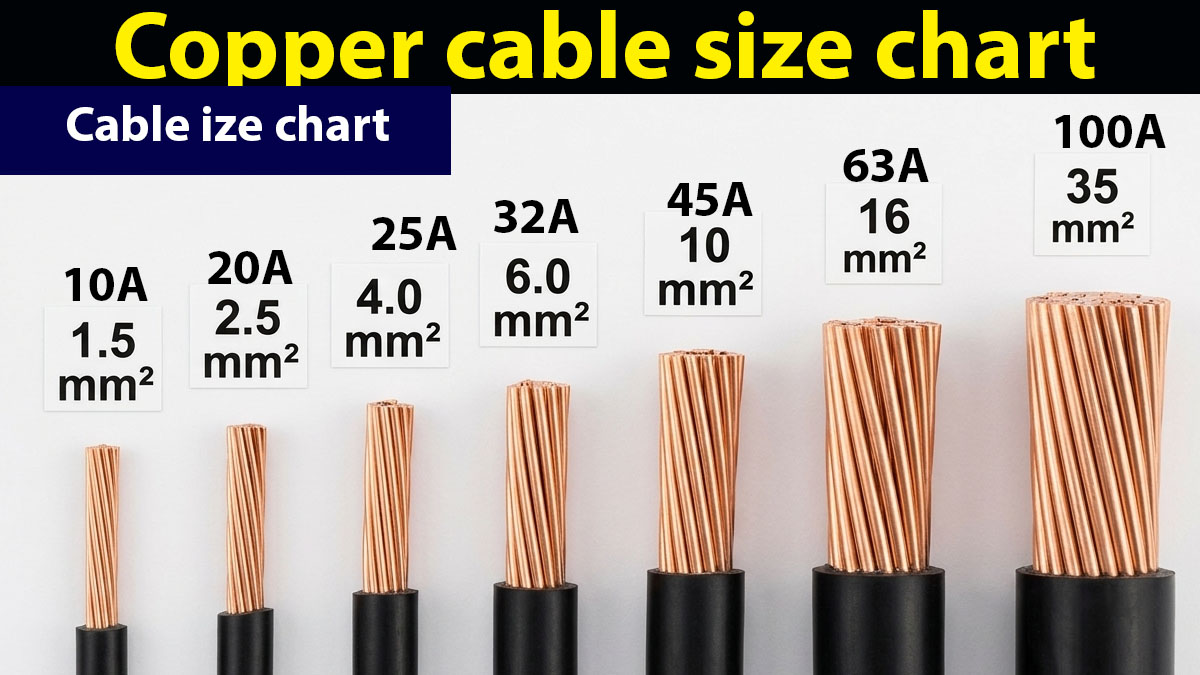
Load is the most important factor. The higher the current (Amps) flowing, the cable will be selected according to that.
For Example
| Load Current | Typical Cable Size |
|---|---|
| 10 A | 1.5 mm² |
| 20 A | 2.5 mm² |
| 25 A | 4 mm² |
| 32 A | 6 mm² |
| 63 A | 16 mm² |
Note: The actual cable size depends on the installation. For example, if a room is 6m × 6m and a 30000 BTU AC unit is installed in it, the load will increase, for which you will have to choose the correct cable.
2. Cable Length
The farther the cable is installed, the more the cable resistance will increase.
As resistance increases:
- Voltage drop increases.
- Power loss increases. More electricity is used.
- Equipment performance decreases. The risk of burning increases.
For Example
If one house uses a 20-meter cable and another house uses a 120-meter cable, both houses may have the same load, but the cable size of both houses will be different because the longer the cable, the more the voltage drop will be.
3. Supply Voltage
Cable size calculation is according to the supply voltage. The cable will be chosen according to the voltage.
Common Voltages:
- 120 Volt
- 230 Volt
- 240 Volt
- 400 Volt
- 415 Volt
- 480 Volt
In higher voltage systems, for the same power, current (Amps) is lower, which also affects cable selection.
4. Installation Method
The cable installation method, how the cable is installed, can also affect the cable size.
Common installation methods:
- Inside Conduit
- Cable Tray
- Underground
- Free Air
- Wall Mounted
Free Air cable, which usually runs with poles or towers, releases more heat, therefore it can carry more current than a conduit cable.
5. Ambient Temperature
If the temperature becomes higher, it also affects the cable size.
For Example:
- Desert Area
- Roof Installations
- Boiler Rooms
- Outdoor Cable Tray
- Industrial Plants
At such places, engineers apply a derating factor so that the cable remains safer and works at a safe temperature.
6. Conductor Material
Generally, conductor material, which makes wire windings and is used in motors, comes under conductor material.
What is Cable Size Calculator?
Cable Length
calculator-watts-volts-amps-and-pf-single-phase-3-phase/
Copper
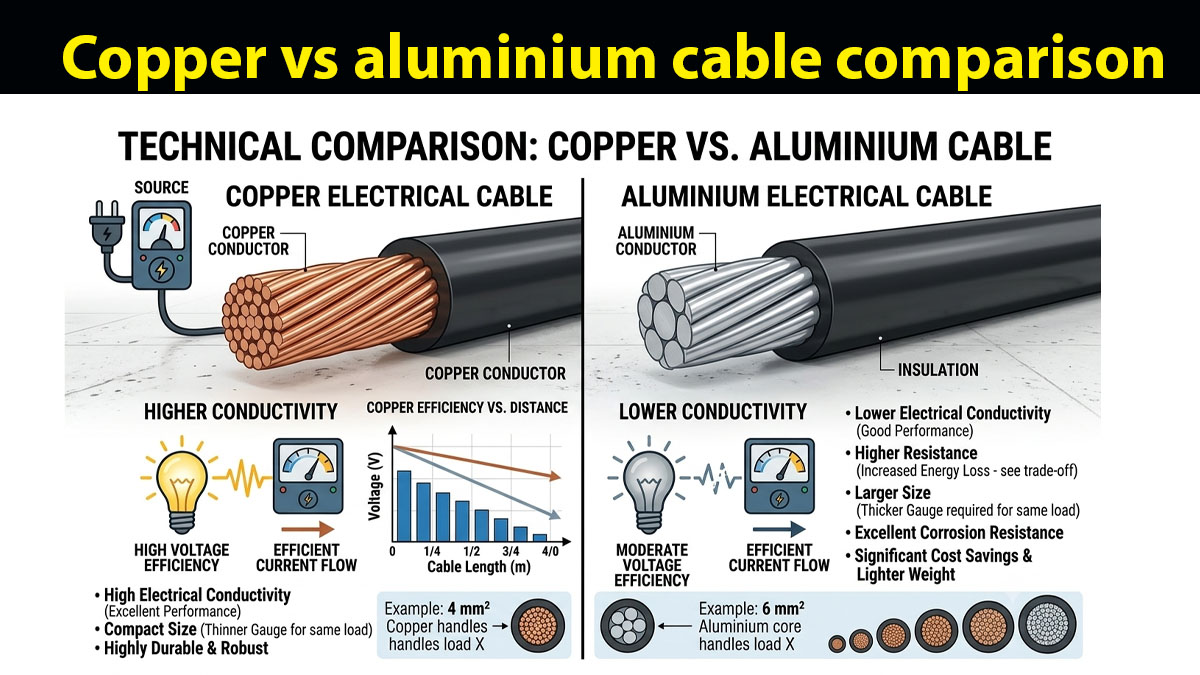
Advantages of Copper:
- Conductivity is very good. It does not heat up much.
- It is flexible.
- It carries more current in a smaller size. It works with very low amps.
- Service life is long.
- Corrosion is less.
Aluminium Cable
Advantages of Aluminium:
- Cost is lower. But amps are higher.
- Weight is lighter.
- Suitable for large power distribution systems.
Aluminium cable is less conductive than copper. If the copper cable size is smaller, then the aluminium cable size has to be kept larger, but aluminium cools down quickly after heating.
Common Types of Electrical Cables
PVC Cable
PVC cable is mostly used in residential buildings and commercial buildings.
Its working temperature is up to 70°C.
XLPE Cable
XLPE cable is used for industrial machinery.
It can easily handle higher temperatures and is better than PVC cable because it can withstand higher temperatures.
Armoured Cable
It is used underground and is also used in places where there is water, plumbing, mechanical work, or where protection is required.
Flexible Cable
It is used for electrical equipment like extension leads, lights, fans, etc. It is also used wherever any machine needs to be moved.
Single-Core Cable
This cable is mostly used in wiring installations. It is used in electrical panels, switches, junction box wiring, etc.

Common Mistakes While Selecting Cable Size
Many problems happen only because of cable selection.
These mistakes should be avoided:
- Selecting the cable only by looking at the breaker.
- Ignoring voltage drop in long cable runs.
- Ignoring ambient temperature.
- Ignoring the installation method.
- Keeping the aluminium cable size equal to the copper cable.
- Selecting the cable without calculation by looking at previous projects.
All these problems can be avoided if the installation is done according to engineering and electrical formulas.
How to Calculate Cable Size?
In cable size calculation, the size cannot be known just by looking at the current (Amps). There are many steps that have to be followed. A professional electrical engineer follows all the steps given below.
- Load Power (W or kW)
- Current (A)
- Supply Voltage
- Single Phase or Three Phase System
- Cable Length
- Voltage Drop
- Installation Method
- Ambient Temperature
- Conductor Material (Copper or Aluminium)
Only after following all these steps is the actual cable selected.
Step 1 – Calculate Load Current
First of all, the electrical load current is calculated.
Single-Phase Formula
Current (A) = Power (W) ÷ (Voltage × Power Factor)
For Example One AC is 3000 watts and the other is 2000W.
Load = 5000 W
Voltage = 230 V
Power Factor = 0.9
Current = 5000 ÷ (230 × 0.9)
Current ≈ 24.15 A
For this load, first the current (Amps) will be calculated, then the cable will be selected.
How AI is Transforming the Electrical 2026
Three-Phase Formula
Different formulas are used in a 3 Phase system.
Current (A) = Power (W) ÷ (√3 × Voltage × Power Factor)
For Example One Motor 15kW
Motor Load = 15 kW
Voltage = 400 V
Power Factor = 0.85
Current = 15000 ÷ (1.732 × 400 × 0.85)
Current ≈ 25.5 A
Now you can check it in your own way and find the final cable size by checking the installation method and voltage drop.
What is Voltage Drop?
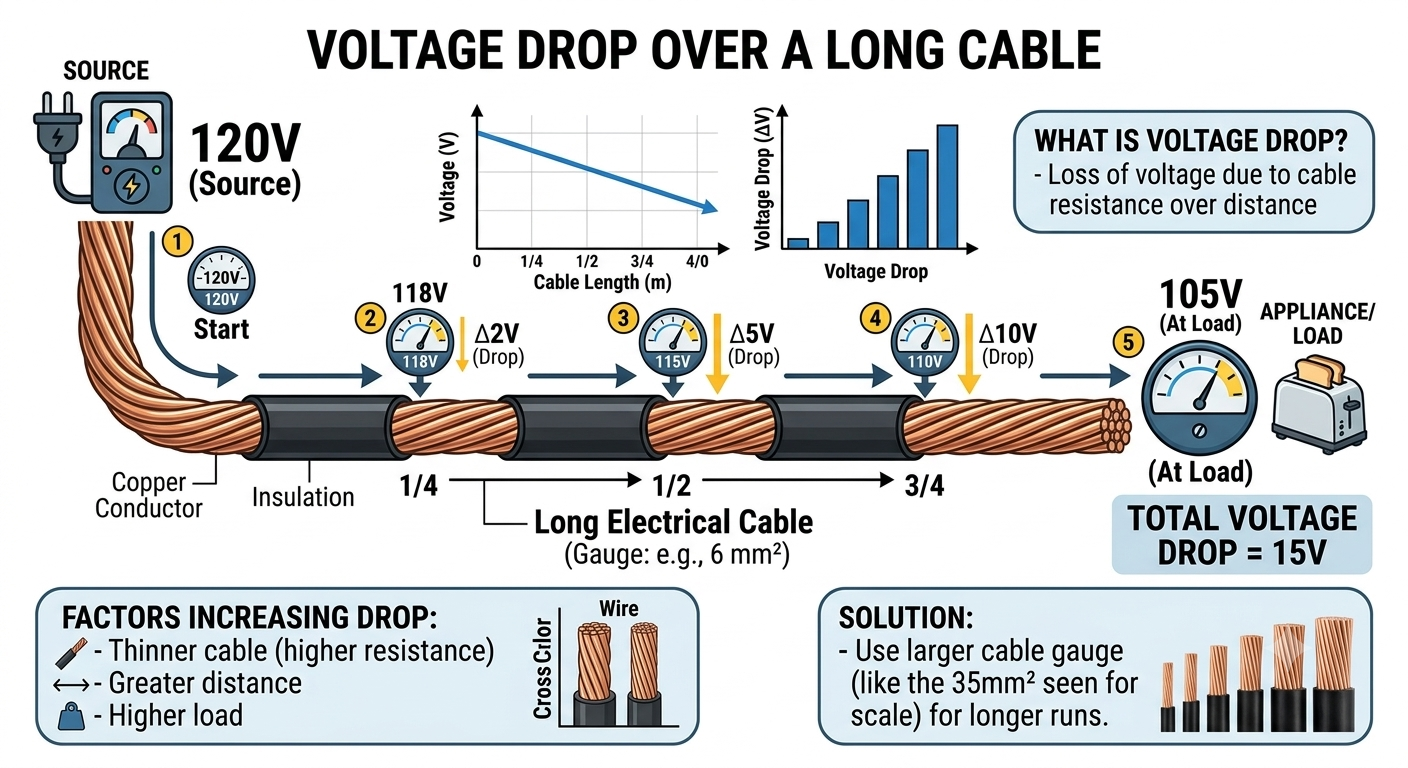
When current is passing through a cable, because of the cable length and higher resistance, voltage is lost and the current does not have the speed that it should have.
This is called voltage drop.
If the voltage drop crosses its limit, the common reasons are given below:
- The brightness of lights becomes low, full light does not work.
- Motors can heat up and the speed becomes low.
- Air conditioner performance may decrease. Compressor does not work properly and stops after heating.
- Equipment does not start properly. If it starts, it trips immediately.
- Energy loss increases, which causes a lot of loss.
Whenever you select a cable, always calculate the voltage drop. It is very important.
Voltage Drop Formula
By using the voltage drop formula, you can select the cable.
Single Phase
VD = (2 × L × I × R) ÷ 1000
Here formula
- VD = Voltage Drop (Volt)
- L = Cable Length (Meter)
- I = Current (Ampere)
- R = Cable Resistance
- 2 = Go & Return Length
Three Phase
VD = (√3 × L × I × R) ÷ 1000
The 3-phase formula is a little different because the return conductor concept is different in it.
Acceptable Voltage Drop
According to international standards, the common installation and recommended voltage drop are given below.
| Installation | Recommended Voltage Drop |
|---|---|
| Lighting Circuits | Maximum 3% |
| Power Circuits | Maximum 5% |
| Industrial Systems | Maximum 3–5% |
If you calculate with the help of the voltage drop formula and it becomes higher than these limits, then you will have to increase the cable size.
Copper vs Aluminium Cable
It is very important in cable selection that you also know about the conductor material.
| Copper | Aluminium |
|---|---|
| Better conductivity | Lower conductivity but not higher heat up |
| Smaller cable size | Larger cable size and need mechanical protector |
| Higher cost | Lower cost |
| Higher weight | Lower weight |
| Better flexibility | Less flexible |
| Longer life | Good for large feeders |
Copper wire is mostly used in residential or commercial buildings and works for a long time, while aluminium is mostly used in industrial feeders, residential commercial distribution supply.
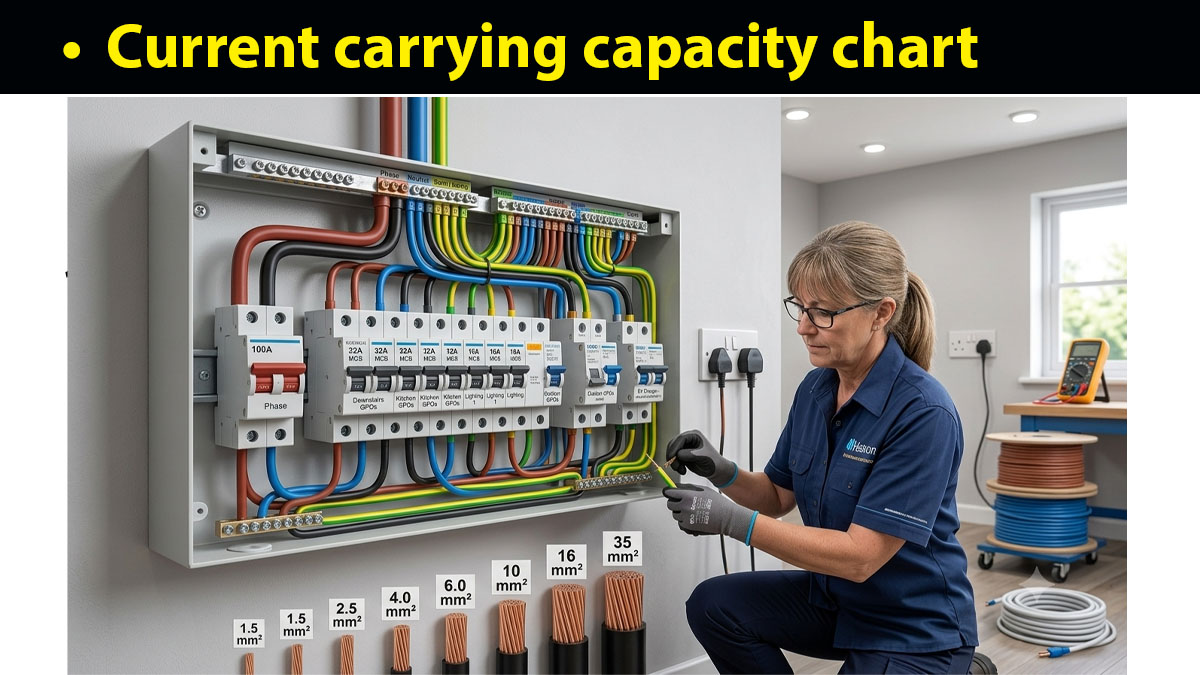
Typical Copper Cable Size Chart
A cable chart has been created.
| Current | Recommended Copper Cable* |
|---|---|
| Up to 10 A | 1.5 mm² |
| Up to 20 A | 2.5 mm² |
| Up to 25 A | 4 mm² |
| Up to 32 A | 6 mm² |
| Up to 45 A | 10 mm² |
| Up to 63 A | 16 mm² |
| Up to 80 A | 25 mm² |
| Up to 100 A | 35 mm² |
| Up to 125 A | 50 mm² |
Note: This is a general reference table. For example, according to the load of any equipment like AC, refrigerator, heater, etc., you can choose it, but the actual cable size can be verified according to the installation method, temperature, air, underground, PVC, XLPE, etc., electrical formulas, or local code.
Practical House Example 1
In one house the total load is 5 kW, which is a normal house load.
Supply Voltage = 230 V
Power Factor = 0.9
Current ≈ 24 A
If the cable length in this house is up to 15–20 meters and the installation is normal, then the engineer will recommend a 6 mm² copper cable. But the final selection is only possible after calculating the voltage drop according to the protective device.
Air Conditioner Practical No. 2
For Example: One 2-ton AC and its running current is 18 to 22 Amps, which can be lower or higher according to the model.
How to select the cable for this load is given below.
- Current
- Starting Current
- Cable Length
- Breaker Size
- Installation Method
All these steps are followed.
3 Phase Motor Practical No. 3
Motor Rating = 15 kW
Supply = 400 V
Power Factor = 0.85
Calculated Current ≈ 25.5 A
Engineers can select the cable size after calculating the voltage drop and checking the installation method.
Benefit Tips for Engineering
- Do not select the cable by breaker rating.
- Always calculate the voltage drop after checking the cable length.
- Apply a derating factor in higher temperature areas or deserts.
- Keep copper and aluminium in mind.
- Always follow IEC, NEC, or local electrical standards.
Questions (FAQs)
1. What is a Cable Size Calculator?
A Cable Size Calculator is an engineer’s tool, with the help of which electricians and engineers can select the correct cable.
2. Why is cable sizing important?
Correct cable sizing protects from overheating, protects from voltage drops, improves the safety and efficiency of electrical equipment, and follows electrical standards.
3. Which cable is better: Copper or Aluminium?
Copper has higher conductivity, better protection, is costly, and has a long workable life. Aluminium is less expensive, suitable for large long feeders and power distribution, has less weight, but requires a larger conductor.
4. How do I calculate cable size?
The general process is load current, cable length, voltage drop, installation method, correction derating factor, and selecting a suitable cable size.
5. What happens if the cable size is too small?
Undersized cable causes overheating, insulation damage, voltage drop, breaker tripping, and increases fire risk.
6. What happens if the cable size is too large?
Oversized cable has a long life but too much installation cost, and the conduit does not match the cable size.
7. What is voltage drop?
Current is travelling in a cable, and because the cable length is longer and the resistance increases, voltage drop occurs.
9. Which standards are used for cable sizing?
The standards include IEC, NEC, and BS 7671.
10. Can I select a cable based only on breaker size?
No. Never select the cable size by looking only at the breaker; it can be risky.
Conclusion
Selecting the correct cable makes the electrical installation safe, prevents voltage drop, keeps the equipment safe, and a Cable Size Calculator makes your work much easier.
